

Blog Details

How to Discover Better Options Setups with Option Surfer - Flowtopia

Most traders do not struggle with finding ideas. The real problem is choosing the right contract inside a noisy options chain. With dozens of strikes, expirations, and liquidity differences, contract selection often turns into guesswork.
Option Surfer helps solve that. It is Flowtopia’s options chain analysis tool designed to filter contracts by liquidity, activity, strike distance, and expiration, making it easier to match a contract with a specific trade idea.
Used properly, Option Surfer is not just an options scanner. It is a structured way to build better options trading setups by reducing noise and aligning contract choice with the expected move, timing, and risk.
Why finding good setups gets harder inside the option chain
The real problem starts once that initial idea leads you into a crowded options chain.
You may be bullish on a name, see strong flow, or notice momentum building, but the chain still presents dozens of possible contracts. Small changes in strike, expiration, or liquidity can ruin execution. That is why experienced traders do not treat the chain like a menu. They treat it like a filtering problem.
When traders talk about options trading setups, they often blur two different decisions: whether the market is worth trading in the first place, and which contract actually expresses that idea well. Option Surfer is useful because it addresses the second task directly.
What usually goes wrong
- Traders chase the cheapest premium instead of the cleanest structure.
- They choose expirations that do not match the expected timing of the move.
- They ignore liquidity, then pay for it through poor fills and wider spreads.
Those mistakes are common because most traders are still searching manually. A focused approach to using an options trade scanner looks very different. You are not asking which contract looks exciting. You are asking which contract best matches the thesis, timing, and risk profile.
What Option Surfer is really helping you do
Flowtopia positions Option Surfer as a way to narrow contracts faster by filtering for liquidity, activity, strike distance, and expiration. In practice, those filters help you rule out weak contracts early, before you waste time convincing yourself they might still work.
Used well, Option Surfer removes unusable contracts, aligns contract choice with the trade structure, and makes review repeatable enough to compare opportunities across names.
That is why Option Surfer works better as part of a decision process than as a simple scan tool. A real setup process starts with context, then narrows toward execution. If you already use Real-Time Options Flow to track unusual activity, WAVE Indicator to confirm pressure, or the Features overview to move between tools, Option Surfer fits naturally as the contract-selection layer.
Liquidity, strike distance, expiration, and activity do not have equal weight in every setup. For a fast breakout, timing and strike placement may matter most. For a swing idea, contract durability may matter more. A disciplined options contract finder process is really about knowing which variable deserves priority for the trade in front of you.
Start with the setup, not the contract
A weak process starts in the chain. A stronger one starts before it.
If you are using Flowtopia correctly, Option Surfer should come after you already have a reason to care about a ticker. That reason might be unusual sweeps, repeated premium hitting the same strike, a shift in dealer positioning, or a change in smart-money pressure. Flowtopia’s educational content consistently emphasizes context around flow, open interest, and institutional intent. The chain should help refine a trade idea that already exists, not manufacture conviction where there is none.
For example, maybe you notice aggressive call flow ahead of a technical breakout. Maybe the same strike keeps printing with size. Maybe the tape suggests urgency rather than passive positioning. At that point, you are not browsing blindly anymore. You are trying to build one of several possible options trading setups around a real market narrative.
A simple pre-chain checklist
- What is the underlying thesis?
- How quickly do I expect the move to happen?
- Do I need leverage, staying power, or flexibility?
- Is the setup flow-led, chart-led, or event-led?
That short list keeps it in its proper role as an options opportunity scanner that helps you choose expression, not invent conviction.

How to use Option Surfer to narrow the field
Once the thesis is clear, the job becomes much easier. You are no longer reviewing the entire chain. You are reducing the field step by step.
Start by filtering out illiquid contracts. Even a strong directional idea can become a bad trade if the spreads are sloppy or the contract is thin. Then narrow by expiration. A breakout expected in one or two sessions should not automatically push you into far-dated premium, and a swing idea probably should not rely on contracts that leave no room for timing error.
From there, adjust strike distance. Traders often oversimplify this part by choosing between “cheap out-of-the-money” and “safer in-the-money,” but the better question is whether the strike still gives the setup room to work without making the breakeven unrealistic. This is where Option Surfer becomes more than an options trade scanner. It lets you compare contract structure against the behavior you actually expect, not just against the premium you want to pay.
If you want more context before committing, it also makes sense to pair that contract review with Flowtopia’s education on how to read open interest and volume in options flow. Those guides reinforce the same point: contract selection works best when it matches the market story behind the trade.
Three setup types where Option Surfer is especially useful
Option Surfer can help in many situations, but it becomes especially valuable when the setup is clear and the contract choices are still crowded.
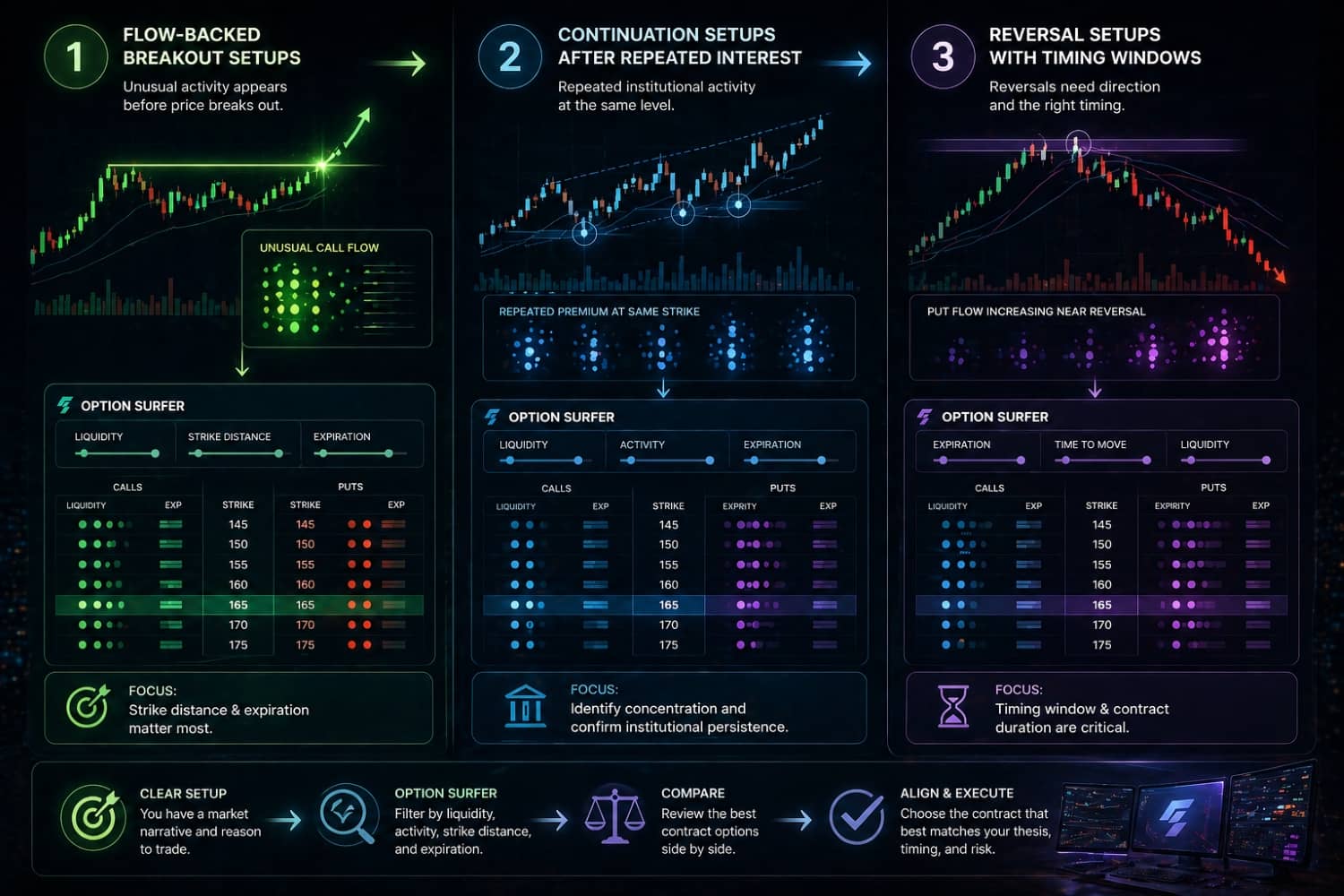
1. Flow-backed breakout setups
These are situations where unusual activity appears before price fully expands. It is not enough to identify bullish or bearish pressure. You still need a contract that can respond well without relying on an unrealistic move. For options trading setups built around breakout potential, strike distance and expiration usually matter more than simply finding the lowest premium.
2. Continuation setups after repeated institutional interest
Sometimes the better signal is not one dramatic print but repeated attention at the same area of the chain. When activity keeps clustering around a strike or expiration, Option Surfer helps isolate where that concentration is building. In that context, it works less like a generic options contract finder and more like a confirmation layer for institutional persistence.
3. Reversal setups with clear timing windows
Reversal trades are often harder because they demand both directional accuracy and better timing. If the move takes longer than expected, the contract can decay even when the thesis is eventually right. For options trading setups built around reversals, Option Surfer helps traders stay honest about timing and avoid contracts that only work under perfect execution.
What separates a better setup from a tempting one
A lot of poor trades look good at first glance. They have movement, narrative, and maybe even a burst of flow behind them. What they lack is alignment.
A better setup usually has alignment across the thesis, the contract structure, and the time horizon. In stronger setups, the strike is not picked just because it is cheap, the expiration is not chosen just because it is close, and the flow is not read in isolation. That is why a disciplined trader uses Option Surfer as an options opportunity scanner only after deciding what the trade needs to accomplish.
Before entry, it helps to pressure-test the idea:
- The contract should fit the expected move, not an exaggerated version of it.
- The expiration should give the thesis enough time to play out without becoming unnecessarily inefficient.
- The liquidity should be good enough that execution does not distort the edge.
When those pieces line up, the chain starts to support the trade instead of distracting from it. That is when options trading setups stop being vague ideas and become structured decisions.
Building a repeatable workflow around Option Surfer
A stronger process gives each step a clear role. Start with market context, confirm the setup, then use Option Surfer to refine contract selection.
A practical workflow might look like this:
- Identify interest through price action, flow, or a catalyst.
- Confirm direction or pressure with supporting context.
- Use Option Surfer to filter contracts by liquidity, expiration, and strike fit.
- Compare a few viable contracts instead of scanning the entire chain.
- Decide based on alignment between thesis, timing, and contract structure.
This approach reduces noise and improves consistency. Instead of reacting to random contracts, you move from idea to execution through a structured process. Over time, that also makes it easier to review trades and understand whether the issue was the setup, the timing, or the contract choice.
Final thoughts on discovering stronger setups
Good traders do more than read direction well. They also know how to choose the right contract for the idea in front of them.
That is the practical case for Option Surfer. It helps bridge the gap between having a trade idea and choosing the contract that actually fits it. If you already have a market view, a timing window, and a reason for the trade, it can function as a serious options contract finder rather than a screen full of distractions. And when it is combined with Flowtopia’s broader flow tools, it becomes much easier to build options trading setups that are structured, selective, and grounded in actual market context.
If you want a cleaner way to move from smart-money signals to contract selection, Flowtopia’s Option Surfer is worth using inside that broader workflow rather than as a standalone shortcut.
Similar Blog You
May Like
Understand how institutional money moves and turn complex options data into clear, actionable insights in real time.


Join traders using real-time options flow, institutional data, and advanced tools to make faster, more informed decisions.