
Track Smart-Money Momentum with More Clarity
Wave Indicator


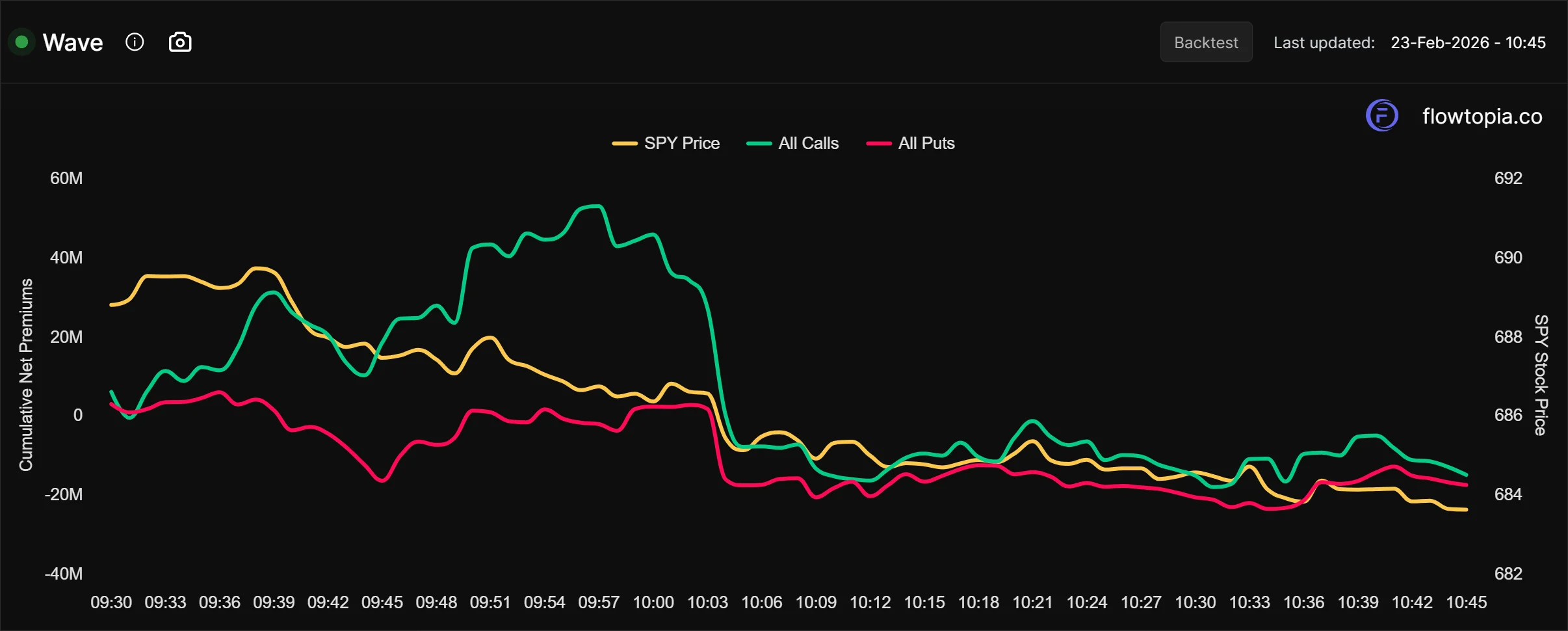
This tool is designed to turn complex options flow into a more readable momentum view. By visualizing how premium shifts across calls and puts evolve during the session, it helps traders spot changes in pressure, follow developing sentiment, and understand whether positioning is becoming more supportive or more defensive.
This is a momentum indicator built from real options flow and positioning data. Instead of relying only on price movement, it helps traders read how call and put pressure may be shifting beneath the surface by turning complex flow activity into a cleaner, more interpretable signal.
That matters because momentum can begin to change before it becomes obvious on a chart. By giving traders a clearer view of developing pressure and sentiment shifts, the indicator can help add context to trade ideas, improve timing, and support a more informed read on how positioning may be evolving.
For a deeper look at how this indicator works and how traders use it in practice, read the full guide: Wave Indicator Explained: How to Track Smart Money Flow
The model is built to interpret momentum through the flow and positioning behavior developing beneath price. Rather than relying on a single input, it draws from multiple options-based signals to help traders understand how pressure may be shifting during the session.
1️⃣ Call and Put Premium Shifts: Tracks how premium is moving across calls and puts to show where directional pressure may be building or fading.
2️⃣ Aggressive Buying and Selling Pressure: Analyzes whether flow appears more aggressive on the call side or the put side, helping traders read changes in conviction more clearly.
3️⃣ Directional Flow Intensity: Looks at the strength and persistence of flow to better understand whether momentum appears to be strengthening, weakening, or starting to shift.
4️⃣ Positioning Behavior Over Time: By following how flow develops during the session, it helps traders see whether market pressure is becoming more supportive, more defensive, or less decisive.
This signal is most useful when it is read as a measure of changing pressure, not as a standalone trigger. Instead of reacting to every short-term fluctuation, the goal is to watch how momentum builds, weakens, or begins to shift as flow develops during the session.
When the reading begins to build in one direction with more consistency, it can suggest that pressure is becoming more concentrated rather than remaining scattered or indecisive.
A shift in the reading can help traders recognize when call or put pressure is starting to lose strength, reverse, or become less convincing than it appeared earlier in the session.
This tool becomes more useful when viewed alongside price. If price and flow pressure are moving in the same direction, that alignment may add context. If they begin to diverge, that may deserve closer attention.
It works best as part of a broader process. Many traders use it to add context around timing, sentiment, and flow strength rather than treating it as a signal that should be followed in isolation.
This indicator is designed to give traders more than a simple momentum reading. It helps turn complex options flow into clearer context, making it easier to recognize shifts in pressure, improve timing, and stay more aligned with how sentiment may be developing during the session.
It can help traders notice when pressure begins to strengthen, weaken, or change direction before that shift becomes fully obvious through price alone.
By showing how momentum is developing beneath the surface, it can help traders approach entries and exits with a more informed view of changing conviction.
Not every move in price reflects meaningful positioning. This view can help traders focus on momentum that appears more supported by real flow activity.
Instead of relying on isolated prints or short-term reactions, traders can use it to follow how pressure evolves over time and develop a more consistent process for reading market sentiment.
Many momentum tools rely heavily on price action alone, which can make it harder to understand what may actually be driving a move beneath the surface. This indicator is different because it is built from real options flow and positioning behavior rather than recent price movement alone. That gives traders a more informed way to read momentum by showing how pressure may be building, fading, or beginning to shift through actual flow activity.
Instead of reacting to every small fluctuation, it is designed to help traders focus on the quality and persistence of pressure. By translating complex options flow into a cleaner momentum view, it becomes easier to follow whether buying or selling pressure appears to be gaining conviction during the session. This makes the signal more useful in live market conditions, where speed matters but raw flow can often feel noisy or difficult to interpret on its own.
It also becomes more powerful when used as part of a broader workflow. When paired with tools like Real-Time Options Flow, GEX, and Historical Dashboard, it helps traders connect momentum, positioning, and context in a more structured way. Rather than serving as a shortcut, it works best as an added layer of clarity inside the bigger picture.
WAVE is built for traders who want more context than price action alone can provide. It is especially useful for people who rely on options flow to understand how momentum, sentiment, and positioning may be developing during the session. Rather than acting as a simple price-based signal, This tool is better suited for traders who want a more structured read on changing pressure and a clearer way to interpret what may be happening beneath the surface.
WAVE indicator becomes even more useful when it is viewed alongside other tools that add context to momentum and help traders build a more complete read on market behavior. While WAVE helps interpret changing pressure and sentiment through options flow, related features can help explain where that pressure is coming from, how it is being expressed, and whether similar patterns have appeared before.
✅ Real-Time Options Flow helps traders monitor unusual activity, large premium trades, and changing positioning as it develops during the session. When used with WAVE, it provides a clearer view of the flow activity behind momentum shifts.
✅ GEX (Gamma Exposure) adds broader market structure by helping traders understand potential support, resistance, and dealer positioning levels. This can help put WAVE signals into a wider market context.
✅ Top Flow Leaderboard helps surface the tickers and contracts drawing the most notable options activity. Paired with WAVE, it can help traders connect momentum changes with where attention and premium flow are concentrating most.
✅ Historical Dashboard gives traders the ability to review past options flow and compare current activity with previous sessions. This can make it easier to study whether similar momentum patterns have appeared before and how they developed over time.
Join traders using real-time options flow, institutional data, and advanced tools to make faster, more informed decisions.